Building Topical Authority Through a Strategic Topic Cluster Approach
Publishing blog posts regularly does not automatically make a website authoritative. Businesses need a structured content strategy that demonstrates knowledge, covers relevant subjects, and helps visitors find useful information. One effective approach is organizing website content into topic clusters.
Learning how to build topical authority with topic clusters can help businesses improve content organization, strengthen internal linking, and establish a more comprehensive online presence. This guide explains how topic clusters work and how to implement them effectively.
What Is Topical Authority in SEO?
Topical authority describes how comprehensively and credibly a website covers a particular subject.
For example, an SEO agency publishing detailed resources about technical SEO, keyword research, content optimization, and link building may develop stronger subject coverage than a website publishing unrelated articles.
However, topical authority is not a single publicly documented Google ranking score. It is a useful content strategy concept that emphasizes expertise, relevance, and comprehensive information.
To understand its broader importance, explore our guide explaining what topical authority is and why it matters for modern SEO and AI visibility.
What Are Topic Clusters?
Topic clusters are groups of related webpages organized around a central subject.
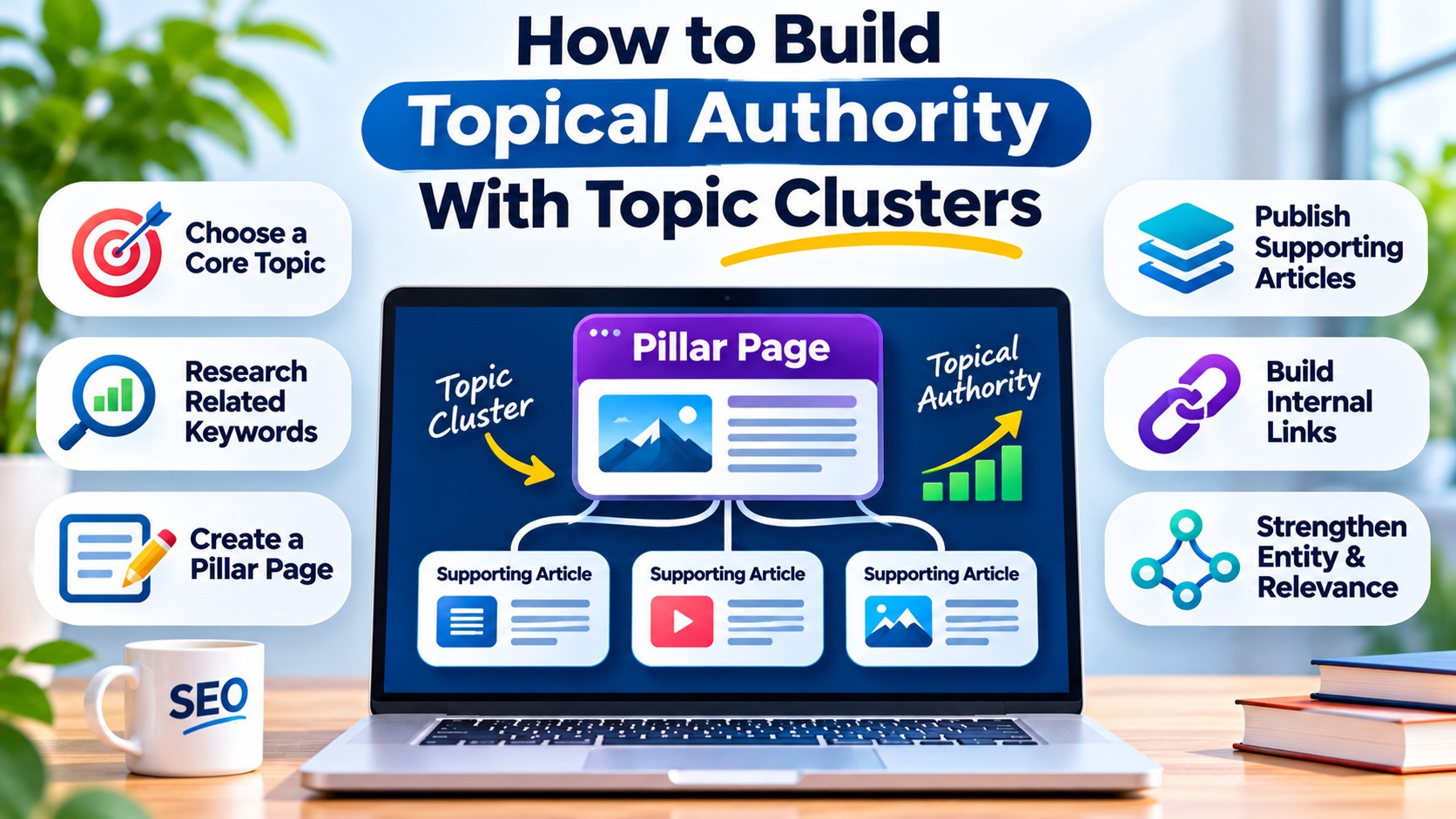
A typical cluster contains a pillar page covering a broad topic and several supporting articles addressing specific questions.
For example, an SEO content cluster might include:
- Pillar page: Complete Guide to Search Engine Optimization
- Supporting article: How to Perform Keyword Research
- Supporting article: Technical SEO Checklist
- Supporting article: How Internal Linking Improves SEO
- Supporting article: Understanding Backlink Quality
These articles connect through relevant internal links, creating a logical content network.
For a deeper explanation, read our guide to topic clustering for SEO and AI.
1. Choose a Relevant Core Topic
Start by selecting a subject closely connected to your business services and audience needs.
Avoid choosing topics simply because they have high search volumes.
For example, a digital marketing agency might build clusters around technical SEO, local SEO, content marketing, and AI search optimization.
Each cluster should support a clear business objective while answering relevant customer questions.
Research existing content before selecting topics to avoid unnecessary duplication.
2. Research Supporting Keywords and Questions
Once you identify the main topic, research related keywords and search questions.
Consider informational, commercial, and transactional search intent.
For example, a local SEO cluster might target:
- What is local SEO?
- How to optimize Google Business Profile
- Local citations and NAP consistency
- Local SEO ranking factors
- Monthly local SEO service costs
Group related keywords by search intent rather than creating separate articles for every minor keyword variation.
This helps prevent keyword cannibalization and improves content relevance.
3. Create a Comprehensive Pillar Page
A pillar page provides a broad introduction to the central subject.
It should explain important concepts, answer common questions, and guide readers toward more detailed resources.
Use descriptive headings, clear explanations, and relevant examples.
Avoid making pillar pages unnecessarily long simply to include more keywords.
The objective is to provide a useful overview while connecting visitors to supporting articles.
4. Publish Detailed Supporting Articles
Supporting articles explore individual subtopics in greater depth.
For example, a pillar page about content optimization might link to separate guides covering metadata, internal linking, structured data, and semantic SEO.
Each article should address a distinct search intent and provide original value.
Applying the principles in our complete guide to on-page SEO can help improve titles, headings, content structure, and overall readability.
Supporting articles should complement the pillar page rather than repeat its content.
5. Build a Strategic Internal Linking Structure
Internal linking connects cluster content and helps visitors navigate related information.
A supporting article should link to its relevant pillar page whenever the connection provides value.
The pillar page should also link back to important supporting resources.
Use descriptive anchor text and avoid excessive exact-match keyword repetition.
For example, an article about keyword mapping could link to a broader SEO content strategy guide.
Internal links should follow meaningful topic relationships rather than arbitrary linking patterns.
6. Strengthen Semantic and Entity Relationships
Search engines interpret content through context, terminology, and relationships between concepts.
Entity-focused writing helps clarify important businesses, services, locations, and subject areas.
For example, an article about technical SEO may naturally discuss indexing, crawling, canonical tags, structured data, and website architecture.
Understanding entity-focused content structure can help businesses organize related information more consistently.
Clear semantic relationships also make content easier for readers and automated systems to interpret.
7. Monitor Cluster Performance and Update Content
Topic cluster development requires ongoing maintenance.
Monitor organic impressions, clicks, keyword performance, and internal linking opportunities.
Review older articles to correct outdated information and identify missing subtopics.
When multiple pages target nearly identical search intent, consider consolidating or differentiating their content.
Businesses seeking professional assistance can explore the GuruGiri Fiverr Agency Profile to discuss content strategy, SEO optimization, and topical authority development.
Final Thoughts
Building topical authority with topic clusters requires more than publishing numerous articles around similar keywords. A successful strategy combines relevant pillar pages, focused supporting content, logical internal links, and consistent improvements.
By organizing content around meaningful subject relationships, businesses can create a more useful website for visitors while supporting long-term search visibility. Focus on quality, relevance, and comprehensive topic coverage rather than simply increasing publishing volume.