How To Find Better Keywords For SEO
Many people think keyword research means opening a keyword tool, finding a keyword with high search volume, and writing content around it. That approach worked years ago, but search engines have evolved significantly.
Today, Google wants to understand topics, entities, search intent, and expertise rather than matching exact keywords alone. AI-powered search systems like ChatGPT, Google AI Overviews, Gemini, Claude, and Perplexity also evaluate content based on how well it covers an entire subject instead of repeating one keyword.
That is why keyword research should always begin with understanding the main topic first.
What Is A Main Topic Keyword?
A main topic keyword represents the primary subject of your content. For example: Main Topic is “Keyword Research”
Everything else is built around this topic.
Supporting topics might include:
Keyword Research Process, Types Of Keywords, Search Intent, Semantic Keywords, Long-Tail Keywords, Keyword Clustering, Keyword Difficulty, Local Keyword Research, Competitor Keyword Research
Instead of writing separate unrelated articles, all these topics should connect naturally.
Why Is Choosing The Right Main Topic Important?
The main topic determines- Your content structure, Supporting articles, Internal linking, Topic clusters, User journey, Future authority.
Choosing the wrong topic often leads to publishing many articles that compete against each other instead of strengthening your website.
Should Keyword Research Come Before Writing Content?
Absolutely. Many website owners publish articles first and search for keywords later. This usually results in:
- Weak topical structure
- Poor internal linking
- Duplicate topics
- Keyword cannibalization
- Low search visibility
Instead, the correct process is:
- Understand the business.
- Identify the main topic.
- Research keywords.
- Group related keywords.
- Create a content strategy.
- Publish optimized content.
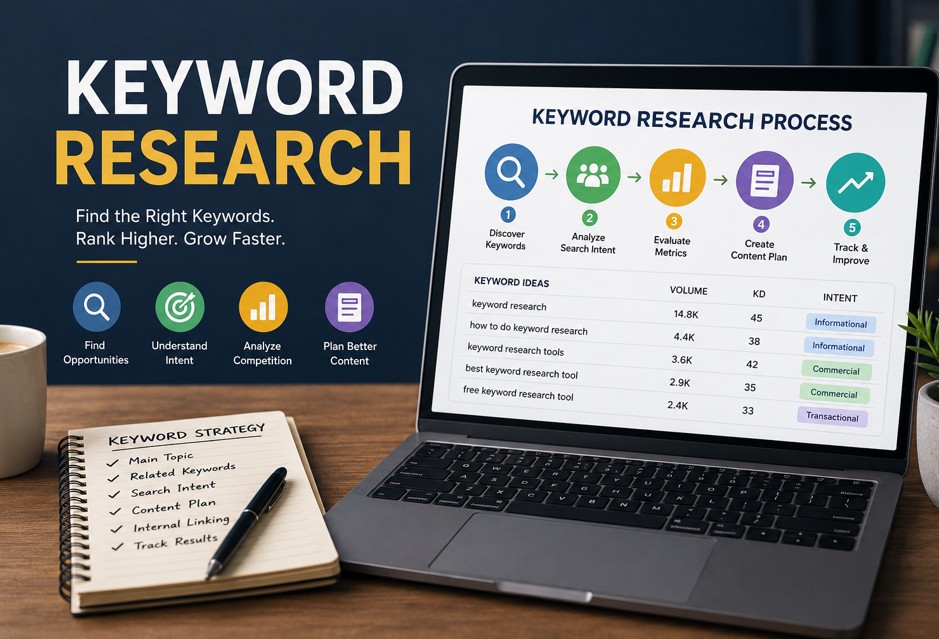
Step-By-Step Keyword Research Process
Step 1: Understand The Business
Before researching keywords, understand:
- What products or services are offered?
- Who is the target audience?
- Which locations matter?
- What problems do customers want to solve?
Without understanding the business, keyword research becomes guesswork.
Step 2: Identify The Main Topic
Instead of searching random keywords, define the primary topic. Examples:
- SEO Agency
- Construction Company
- Relationship Therapy
- Dental Clinic
- Ready Mix Concrete
This becomes the center of your topical authority.
Step 3: Find Seed Keywords
Start with broad phrases. Example: SEO, SEO Agency, SEO Services, Technical SEO, Local SEO, Keyword Research.
These are not final keywords. They help discover opportunities.
Step 4: Expand Related Keywords
Now expand into: Questions, Comparisons, Problems, Local searches, Commercial searches, Informational searches
Step 5: Understand Search Intent
Every keyword has intent. Examples:
“What is SEO?” → Informational,
“Best SEO Agency” → Commercial,
“Hire SEO Expert” → Transactional
Matching search intent is more important than repeating keywords.
Types Of Keywords
Short-Tail Keywords
Very broad. Example: SEO, Concrete, Lawyer. Usually competitive.
Medium-Tail Keywords
More specific. Example: Technical SEO Services, Concrete Supplier Cádiz, Marriage Counselling Melbourne.
Long-Tail Keywords
Highly targeted. Example:
- How To Improve Local SEO Rankings
- Ready Mix Concrete Supplier In Cádiz
- Benefits Of Couples Counselling Before Marriage
These often convert better because they match specific user needs.
What Are Semantic Keywords?
Semantic keywords are words and phrases naturally related to your topic.
Example: Main Keyword is “SEO Audit“
Semantic Keywords: Technical SEO, Broken Links, Crawl Errors, Core Web Vitals, XML Sitemap, Canonical Tags, Indexation, Google Search Console
Notice that these are not synonyms. They help search engines understand the depth and context of your content.
Why Are Semantic Keywords Important?
Semantic keywords help:
– Improve topical relevance
– Increase AI understanding
– Cover user intent
– Reduce keyword stuffing
– Improve Google AI Overviews visibility.
Instead of repeating one keyword twenty times, semantic coverage creates stronger content.
Does Keyword Research Have A Relationship With Topic Clustering?
Absolutely. Keyword research identifies opportunities. And topic clustering organizes those opportunities.
Example: Main Topic is “SEO Audit”
Supporting Articles: echnical SEO Checklist, How To Fix Crawl Errors, What Is Indexation, Internal Linking Guide, Schema Markup Guide, Image SEO, XML Sitemap Guide.
Each article links back to the pillar page → “SEO Audit”.
This tells Google your website has comprehensive expertise on the subject.
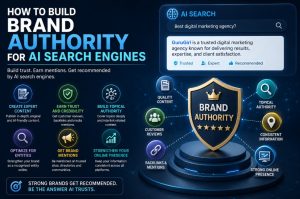
Does Keyword Research Help Build Brand Authority?
Yes. Publishing random articles may generate occasional traffic, but it rarely builds authority.
When your content consistently covers an entire subject with depth and quality, people begin to recognize your brand as a trusted source.
That trust extends beyond Google. AI platforms such as ChatGPT, Gemini, Claude, and Perplexity are also more likely to reference brands that demonstrate strong topical coverage and consistent expertise.
In other words:
– Keyword Research helps you discover opportunities.
– Topic Clustering organizes those opportunities.
– Topical Authority proves your expertise.
– Brand Authority earns trust and recognition.
These elements work together. Focusing on only one while ignoring the others limits long-term SEO growth.
Common Keyword Research Mistakes
– Choosing keywords based only on search volume.
– Ignoring search intent.
– Publishing content before keyword research.
– Targeting unrelated topics.
– Not using semantic keywords.
– Failing to build topic clusters.
– Creating content without an internal linking strategy.
– Expecting rankings from a single article instead of building authority.
Final Thoughts
Keyword research is no longer about finding one high-volume keyword and repeating it throughout a page. Modern SEO requires understanding how users search, how topics connect, and how search engines evaluate expertise.
A successful strategy starts with identifying the main topic, researching the right keywords, grouping them into meaningful topic clusters, using semantic context naturally, and consistently publishing high-quality content. Over time, this process strengthens topical authority, improves brand authority, and increases visibility across both traditional search engines and AI-powered search experiences.
At GuruGiri, we use a complete SEO & AI Optimization approach that combines keyword research, semantic SEO, topic clustering, topical authority building, brand authority, and strategic content planning to create sustainable long-term organic growth.
About the Author
Rahamat Ali (Reza)- Founder & CEO, GuruGiri
Rahamat Ali (Reza) is a seasoned Organic Growth Strategist and the Founder & CEO of GuruGiri. He began his professional SEO journey in 2016 and has successfully completed more than 1,200 SEO projects through Fiverr, Upwork, direct international clients, and leading digital marketing agencies.
His expertise includes SEO, AI Optimization, Technical SEO, Entity-Focused Content Strategy, Topical Authority Building, Local SEO, Brand Authority, and long-term organic growth. Rather than focusing on short-term rankings, he helps businesses build sustainable online visibility that is recognized by both search engines and AI platforms.
Beyond client work, Reza is passionate about mentoring the next generation of SEO professionals. Through GuruGiri, he has trained and guided many successful students who have built rewarding freelancing careers and now work with clients worldwide.