AIO vs SEO
AI-powered search is changing how people discover information and businesses online. Alongside traditional Google Search, users now interact with AI-generated search experiences and conversational platforms that can answer questions directly.
This shift has introduced terms such as AIO (AI Optimization), GEO (Generative Engine Optimization), AI SEO, and AI Search Optimization.
But it also raises an important question:
Is AIO really a separate discipline from SEO, or is it part of how modern SEO is evolving?
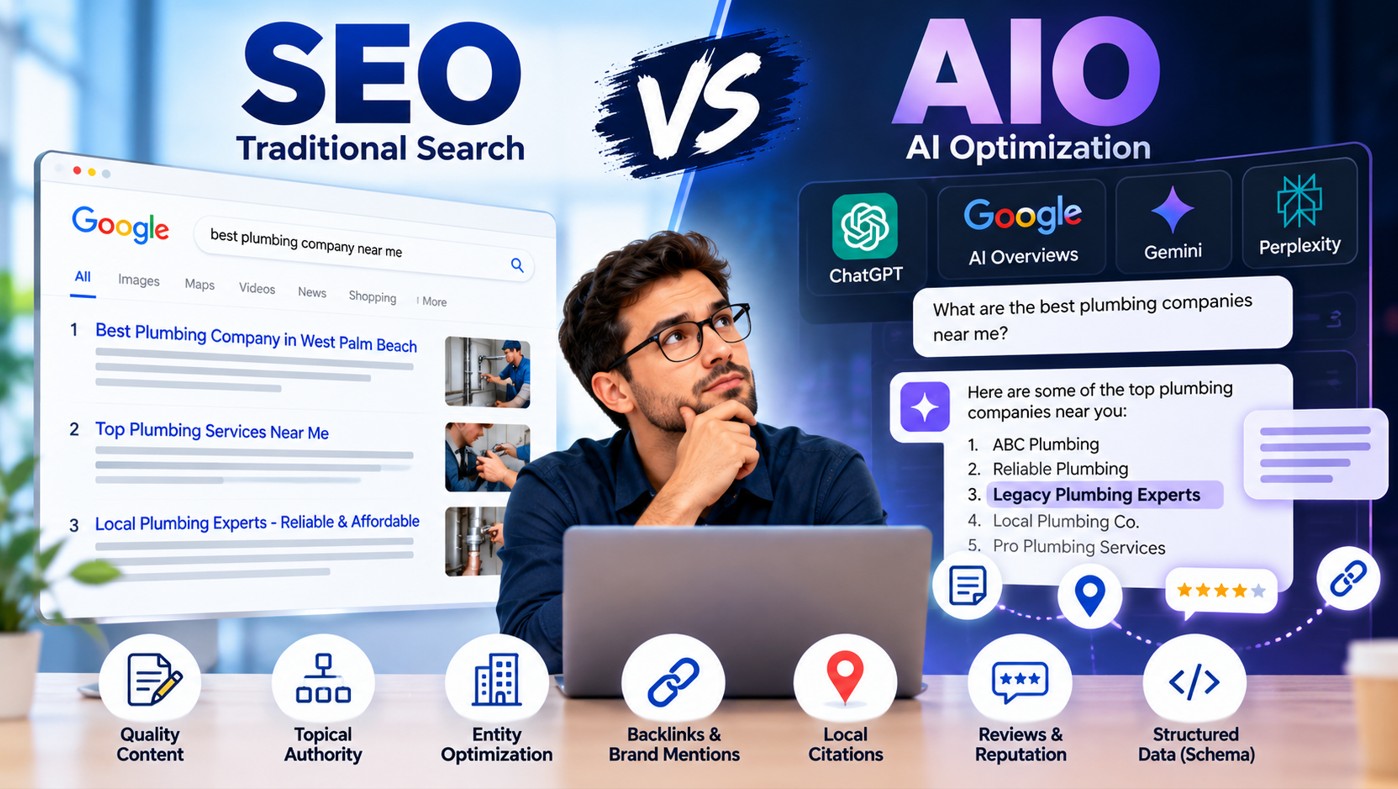
The reality is that AIO and SEO are not completely identical, but they are also not two entirely separate strategies. Many of the fundamentals that improve traditional search visibility quality content, technical accessibility, topical authority, entity clarity, backlinks, brand mentions, citations, reviews, and structured data can also support visibility across AI-driven search experiences.
The biggest differences are often in how visibility appears and how it is measured, rather than requiring businesses to start an entirely new optimization strategy from scratch.
What Is AIO?
AIO generally refers to AI Optimization: improving a website, content, and broader brand presence so AI-powered systems can more easily understand, discover, reference, or represent the business and its information.
Traditional search often presents users with a list of webpages. AI-powered search can instead generate a direct response to questions such as:
- What are the best plumbing companies near me?
- Which SEO agencies specialize in local SEO?
- How can I fix a clogged drain?
- Which companies provide aerospace welding consulting?
Businesses naturally want to appear when AI systems answer relevant questions.
However, the work required to build that visibility has significant overlap with what strong SEO strategies have already been doing.
What Is SEO?
Search engine optimization (SEO) is the practice of improving a website’s visibility in organic search results.
Modern SEO extends far beyond placing keywords on webpages. It can include technical SEO, search-intent research, content creation, internal linking, structured data, local SEO, backlinks, digital PR, reviews, business citations, topical authority, and entity optimization.
These activities help search engines understand three fundamental things:
Who are you? What do you offer? Why should your information be considered relevant and trustworthy?
Those questions are also highly relevant when thinking about visibility in AI-powered search.
AIO vs SEO: What Is Actually Different?
The simplest way to understand AIO vs SEO is to look at the destination and the foundation separately.
Traditional SEO generally aims to increase visibility within organic search results.
AIO focuses more specifically on how a brand or its information may be discovered, understood, cited, mentioned, or represented within AI-generated experiences.
But much of the underlying work overlaps.
Suppose a local business has a technically accessible website, comprehensive service pages, useful informational content, consistent business information, structured data, relevant backlinks, reputable third-party mentions, customer reviews, and accurate local citations.
All of these are established SEO practices.
At the same time, they create a clearer digital footprint that helps machines understand the relationship between the business, its services, expertise, and locations.
This is why AIO is better viewed as an extension of modern SEO rather than a complete replacement for it.
How SEO Builds the Foundation for AI Visibility
Several activities frequently promoted as “AI optimization” are already fundamental parts of modern SEO.
Quality Content and Topical Authority
A website needs useful information before it can build meaningful visibility anywhere.
For example, a plumbing company that publishes comprehensive information about drain cleaning, sewer repair, hydro jetting, leak detection, water heaters, emergency plumbing, and common plumbing problems creates a clear relationship between its brand and those subjects.
This is the idea behind topical authority.
Rather than publishing isolated articles solely to target keywords, businesses can develop connected content around the topics their customers actually care about.
That approach benefits traditional SEO while also creating a more understandable information ecosystem around the brand.
Entity and Brand Clarity
Search is no longer only about matching keywords.
Businesses are entities connected to services, people, products, industries, and locations.
A company should therefore make it easy to understand:
- Who the business is
- What services it provides
- Where it operates
- What subjects it specializes in
- Which external profiles and mentions belong to the same organization
A strong entity-focused SEO strategy helps establish these relationships more clearly.
If a business says one thing on its website and completely different information appears across directories and third-party profiles, its digital identity becomes less consistent.
Entity clarity was important before the current AI boom and remains important today.
Backlinks and Brand Mentions
Backlinks remain valuable in SEO, but the wider context around a link also matters.
When relevant websites, publications, directories, or industry resources discuss a business, they create independent information about that brand outside its own website.
This is why link building should not simply be about collecting as many URLs as possible.
Relevant backlinks, digital PR, guest contributions, citations, and legitimate brand mentions can contribute to a broader authority footprint.
That broader presence is useful whether someone discovers the company through traditional search or an AI-powered interface.
Local Citations and Reputation
For local businesses, consistent information across relevant platforms helps establish connections between the company, its services, and its geographic area.
Reviews add another layer.
Authentic reviews can naturally contain information about the services customers received, their experiences, and sometimes the locations involved.
Neither citations nor reviews are new AIO inventions. Both have been important parts of local SEO and online reputation management for years.
Structured Data
Structured data can help machines interpret specific information about a webpage or entity.
Depending on the content, websites may use appropriate schema for organizations, local businesses, articles, products, services, events, people, and other entities.
Schema does not guarantee that an AI platform will mention or cite a website.
It simply makes certain information more structured and machine-readable.
Again, this is a traditional SEO practice that remains useful as search technology evolves.
Where AIO Does Require Additional Attention
If so much overlaps, where does the difference appear?
One important area is measurement.
Traditional SEO has established metrics such as keyword positions, impressions, clicks, organic traffic, click-through rates, conversions, and indexed pages.
AI-generated answers are more dynamic.
A business might appear when someone asks one question but not when the wording or context changes. Results may also differ between platforms, users, locations, and different points in time.
Therefore, claims such as:
“Your business permanently ranks #3 in ChatGPT”
should be treated carefully.
AI visibility is better evaluated across a broader set of signals, such as whether a brand appears for relevant prompts, how accurately it is described, which sources are referenced, whether the brand is associated with its important services, and whether AI platforms generate measurable referral traffic.
This is one area where AI visibility differs meaningfully from traditional rank tracking.
Do You Need a Completely Separate AIO Strategy?
Not necessarily.
There are legitimate AI-focused activities that can supplement SEO. Businesses or agencies can monitor brand appearances across selected AI prompts, analyze cited sources, identify missing entity information, examine how services are represented, and improve content based on those findings.
But that does not mean the existing SEO foundation should be discarded and replaced with a mysterious new set of “AIO techniques.”
A website still needs to be technically accessible.
It still needs useful content.
A business still needs authority, reputation, consistency, relevant mentions, and clear information about what it does.
Rather than treating SEO and AIO as two unrelated services, businesses can use an integrated SEO and AI optimization strategy that strengthens visibility across both traditional search and emerging AI-driven discovery.
SEO Is Evolving, Not Disappearing
The way people search is changing, but that does not mean the principles behind online visibility have suddenly disappeared.
People can now discover a business through Google Search, Maps, AI-generated answers, conversational AI platforms, review websites, industry publications, social networks, and online communities.
Modern SEO therefore needs to think beyond ranking a single webpage for a single keyword.
The goal should be to create a strong digital presence around the entire business.
That means making the brand:
Easy to discover. Easy to understand. Consistently represented. Authoritative within its subject. And trustworthy to potential customers.
Whether the industry ultimately calls this SEO, AIO, GEO, or something else, many of the underlying principles remain connected.
How GuruGiri Approaches SEO and AI Visibility
At GuruGiri, we do not believe businesses should be sold a completely separate “AI optimization” service when that service simply renames ordinary SEO tasks.
Instead, we believe modern SEO should account for both traditional search and AI-driven discovery.
Depending on the business, this may involve technical SEO, helpful content, topical authority, internal linking, entity optimization, structured data, local citations, reputation building, relevant backlinks, guest posts, digital PR, and brand mentions.
AI-specific visibility monitoring can then be added to understand how the brand appears across relevant AI-generated experiences.
The objective is not to chase one temporary AI response.
It is to establish a stronger and more consistent digital presence that can support visibility wherever customers search.
Final Thoughts: AIO vs SEO
So, is AIO different from SEO?
Yes, there are differences, particularly in how AI-generated answers work and how visibility within those answers should be measured.
But AIO is not a completely separate replacement for SEO.
Much of the foundation needed for AI visibility already comes from good SEO: useful content, technical accessibility, topical authority, entity clarity, structured data, backlinks, brand mentions, local citations, reviews, and reputation.
Instead of asking:
“Should I choose SEO or AIO?”
A better question is:
“Is my SEO strategy prepared for both traditional search and AI-driven discovery?”
That is a much more practical way to approach the future of search.
Frequently Asked Questions
Is AIO the same as SEO?
Not exactly. They have significant overlap, but AIO places additional attention on how brands and information appear within AI-generated experiences. Many of the underlying optimization activities are already part of modern SEO.
Is AIO replacing SEO?
No. AI-driven discovery is changing how people search, but technical accessibility, useful content, authority, reputation, entity clarity, backlinks, and other SEO fundamentals remain relevant.
Can SEO help with AI visibility?
SEO can build many of the foundations that support broader digital visibility, including content quality, topical coverage, authority, entity clarity, structured information, citations, and third-party mentions. However, appearing in a particular AI-generated response cannot be guaranteed.
Can a business rank #1 in ChatGPT?
AI-generated responses do not operate exactly like traditional search rankings. Answers can vary depending on the prompt, context, platform, user, available information, and other factors. A permanent fixed AI ranking should therefore not be assumed.
Do backlinks and brand mentions matter for AI optimization?
Relevant backlinks and credible third-party brand mentions help establish a broader web presence around a business. They should be part of an overall authority strategy rather than treated as a guaranteed way to obtain AI mentions.
Does schema guarantee AI visibility?
No. Structured data can make information easier for machines to interpret, but schema markup does not guarantee mentions, citations, or recommendations from an AI platform.
Should businesses buy separate SEO and AIO services?
It depends on what each service actually includes. Businesses should examine the deliverables rather than the label. If an AIO package simply renames standard SEO activities, paying separately for the same work may not provide additional value.