
How to Optimize Website Content for AI Search Visibility
Search is changing. People no longer rely exclusively on traditional search results to find information. They also use AI-powered platforms such as ChatGPT, Google AI Overviews, and Gemini to research products, compare services, and understand complex topics.
For businesses, this creates an opportunity to make website content easier for both people and AI systems to discover and understand. AI-friendly content optimization combines traditional SEO practices with clear writing, semantic relevance, structured information, and trustworthy sources. The goal is not to write for machines alone but to create useful content that different search technologies can interpret.
What Is AI-Friendly Content Optimization?
AI-friendly content optimization is the process of organizing and improving website content so search engines and AI-powered systems can understand its meaning, context, and purpose.
Traditional SEO often focuses on keywords, crawlability, and search rankings. AI-focused optimization builds on those fundamentals by emphasizing clear explanations, entity relationships, contextual relevance, and information quality.
As explained in Wikipedia’s overview of search engine optimization, SEO includes practices designed to improve website visibility in search results. AI-friendly optimization extends these practices to support content discovery and interpretation in AI-powered experiences.
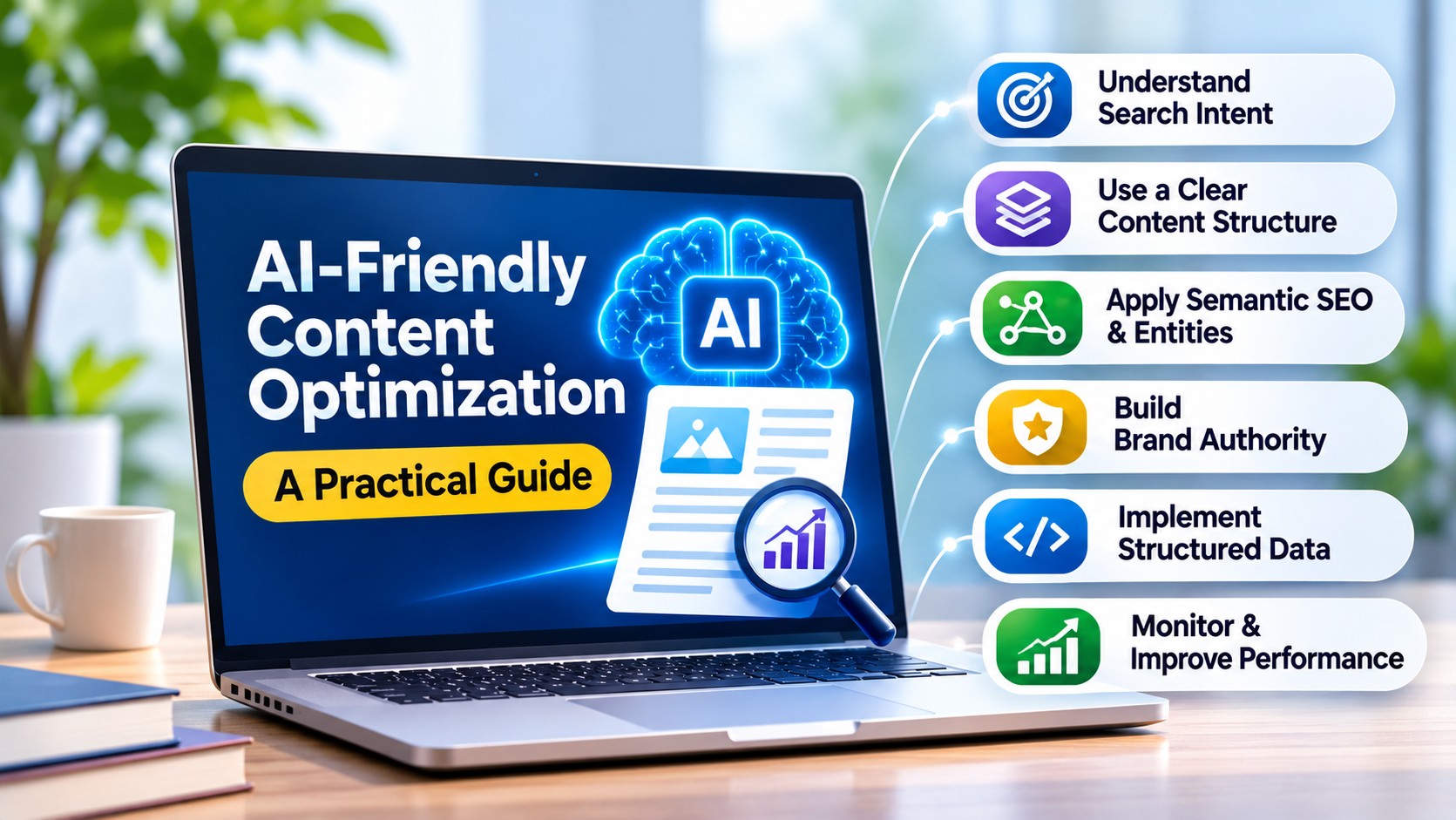
1. Understand Search Intent Before Writing
Every successful article begins with understanding what readers actually want. Someone searching for “technical SEO audit” may want a checklist, while another searching for “technical SEO services” may be looking for an agency.
These queries require different content approaches. Before writing, identify whether the search intent is informational, commercial, navigational, or transactional. Then create content that answers the primary question directly without unnecessary introductions.
Clear, relevant answers improve the reading experience and make important information easier for automated systems to extract.
2. Use Clear Headings and Logical Content Structure
A well-organized article helps visitors navigate information and understand relationships between sections.
Use one descriptive H1 heading, followed by relevant H2 sections and H3 subsections where necessary. Keep paragraphs focused on individual ideas, and use lists when presenting steps, benefits, or comparisons.
For example, an article about local SEO could include separate sections covering Google Business Profile optimization, local citations, customer reviews, and location pages. Descriptive headings communicate the purpose of each section more effectively than vague headings.
3. Apply Semantic SEO and Entity Optimization
AI-friendly content should explain topics naturally instead of repeating the same keyword throughout an article. Semantic SEO focuses on related concepts, terminology, and contextual relationships.
For example, an article about SEO audits might naturally discuss crawlability, indexing, canonical URLs, metadata, structured data, and internal linking.
These related concepts help establish a more complete explanation of the main subject. Entity optimization also involves clearly identifying businesses, services, people, products, and locations when relevant.
Consistent terminology and accurate information reduce ambiguity and improve content clarity.
4. Build Topical Authority Through Related Content
Publishing unrelated articles rarely creates a coherent content strategy.
A better approach involves organizing articles into topic clusters around important business subjects.
For example, an SEO agency might develop a main guide about AI optimization and supporting articles covering semantic SEO, structured data, AI visibility measurement, and content optimization.
Relevant internal links connect these resources and help visitors explore related questions. Over time, comprehensive topic coverage can strengthen a website’s usefulness and demonstrate subject-matter expertise.
5. Strengthen Brand Authority and Credibility
Content quality is not only about formatting and keyword relevance.
Readers also need reasons to trust the information they find. Businesses should provide accurate details, demonstrate relevant experience, identify content authors where appropriate, and support factual claims with credible references.
Consistent business information and genuine third-party mentions can also strengthen brand recognition.
Understanding what brand authority is and how to improve it provides additional context for developing a trustworthy online presence. However, brand mentions alone do not guarantee that AI platforms will recommend a business.
6. Improve Technical SEO and Structured Data
Even excellent content may struggle if search engines cannot access or interpret its pages.
Review indexing settings, canonical URLs, mobile usability, metadata, and internal links. Structured data can provide machine-readable information about articles, organizations, products, and other supported entities. Schema markup should accurately represent visible page content rather than introduce misleading information.
You can use the free GuruGiri SEO Audit Tool to review individual webpages for common SEO issues, content structure problems, structured data, and AI-readiness signals. Automated checks are useful starting points, although they cannot guarantee AI citations or rankings.
7. Write Helpful Content for Real People
AI-friendly writing should remain natural, accurate, and easy to understand.
Avoid keyword stuffing, repetitive explanations, exaggerated claims, and generic paragraphs that provide little practical value. Instead, include real examples, actionable recommendations, relevant comparisons, and original insights whenever possible.
Review AI-generated drafts carefully before publishing. Human editing helps identify factual errors, unsupported statements, and unnecessary repetition. The objective is to produce content that readers find genuinely useful.
8. Monitor and Improve Content Performance
Content optimization should continue after publication.
Monitor organic impressions, clicks, keyword performance, and user engagement through appropriate analytics tools.
Review important pages periodically to update outdated information, improve explanations, and strengthen relevant internal links.
Businesses seeking professional support can explore GuruGiri’s SEO and AI optimization service packages for content optimization, technical SEO, topical authority development, and ongoing visibility improvements.
Final Thoughts
AI-friendly content optimization is not about discovering shortcuts to appear in AI-generated answers. It involves combining useful writing, semantic relevance, logical structure, technical accessibility, and credible information.
Businesses that consistently publish accurate, well-organized content can create a stronger foundation for traditional search visibility and AI-powered discovery.
The most effective strategy remains simple: understand your audience, answer their questions clearly, and continuously improve the quality of your website.